How To Connect Projector To Laptop Windows 10
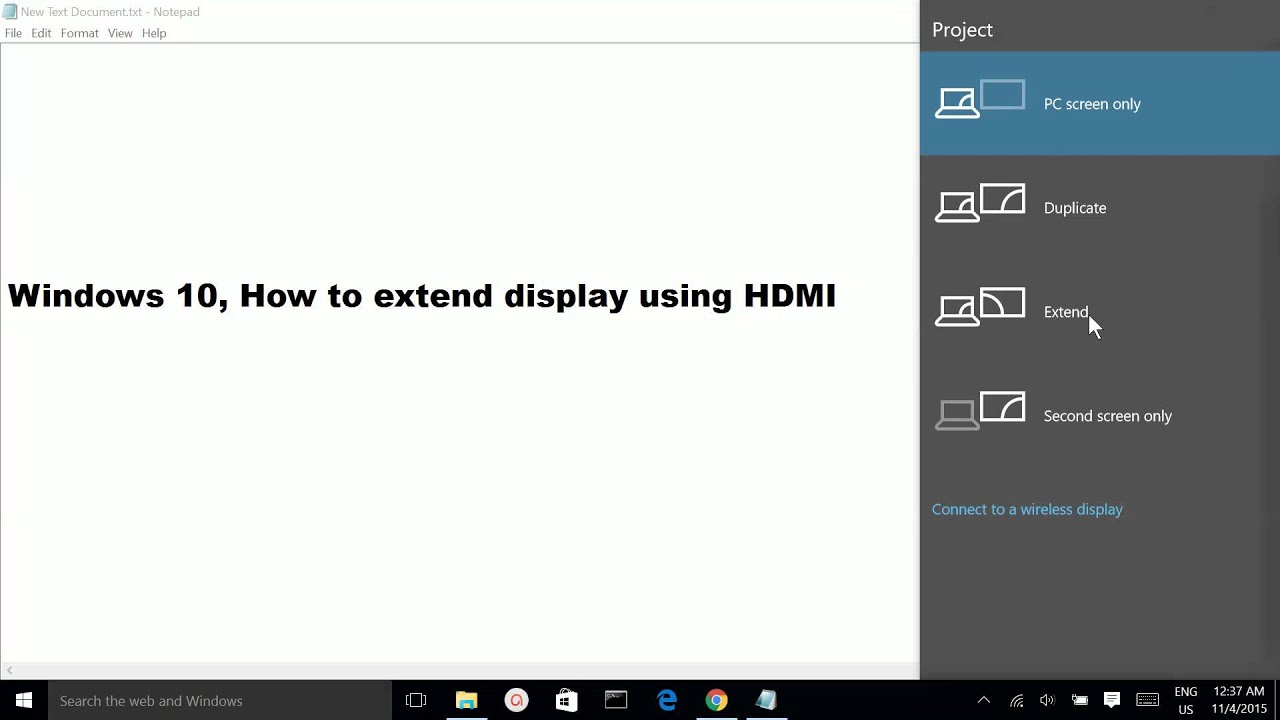
You just can’t.Well, you can, but only with auto-discovery search, you cannot specify the IP address of projector. And it wasn’t an easy way to discover this.So, you have a projector connected to network. And you want to present your screen on that projector via network (fuck this HDMI/VGA mess). It’s a really convenient feature, and you can do it on Windows by pressing hotkey Win + P.The thing is - Windows looks for a projector with an auto-discovery search, but it might fail to find it that way. The other option is to specify IP address of the projector manually, so Windows would connect directly to this particular projector (and it’s actually faster than scanning the whole network).Windows 7 (and Windows 8, apparently) allows you to do that with no problem:However, I couldn’t find such possibility in Windows 10.
I thought, how can it be, maybe I missed something? I even created a question at, but it turned out that nobody knows where to find this in Windows 10.Okay then, I decided to ask.
Surprisingly, they answered in an online-chat pretty quickly and even without asking any questions about my Microsoft account or my license information. Apparently, Microsoft provides support for free for everyone? I didn’t know that, it’s very cool of them, but let’s get back to the problem.Here’s. I’ve spent some time to get her to understand my question, as you can see. But then she right away tried to ditch me to the projector’s vendor documentation/support.

Having failed that she used the “update” trick (implying I have an obsolete version of Windows, which I did, but that wasn’t the issue), and not only that, but she assured me that the desired functionality is available in the latest version of Windows. I said, okay then, I will update, but send me step-by-step instruction (how to connect to a projector by IP address) for this version then, since you are claiming that it has what I want.
But she sent me an e-mail with just an instruction for how to update Windows. Thanks a lot. And needless to say that after I’ve updated my Windows to the latest version it was still lacking this functionality. So the official Microsoft support specialist lied to me:)Okay, I came back to the support page. This one was smarter that the previous one, but again, she tried to ditch me to the projector’s vendor docs/support, and I evaded this maneuver second time.
After that she actually did some research and finally provided me the answer, that in Windows 10 the only way to connect to a network projector is the auto-discovery. And then she gave me a link to apparently her source, and it was just Microsoft forums - you can hardly call this the official source of information. Is it the place where all the Microsoft’s support specialists look for answers? Not really reassuring, if so.So, in order to get an answer to a pretty simple question, I had to spend about an hour of my time and talk with 2 different support specialists.Regarding the problem itself - what was the point to delete such functionality in Windows 10 since it was already implemented in previous versions? Where is the logic in this?Anyway, I created a corresponding feature-request at their, but I doubt it would even get noticed. And I would’ve shared the link to it with you, but this silly thing doesn’t support sharing.Oh, and by the way - Mac OS doesn’t have the ability to connect to a network projector at all: neither via direct IP-address, nor via auto-discovery. You are doomed to use cables (so much for being “wireless”, huh).
If you want to connect your laptop to a projector but don’t know how to do it, don’t worry! You’ve come to the right place! Just follow the steps below and you’ll be able to connect your laptop to the projector easily and quickly!
Here are the steps:.Step 1: Turn off your laptop and the projectorMake sure your laptop and the projector are both turned off before you connect your laptop to the projector. Step 2: Connect your laptop to the projectorBefore connecting your laptop to the projector, you need to know what ports your laptop and the projector have. Please ensure that the video port on your PC matches an available video port on the projector, like DisplayPort ( DP ), HDMI, VGA and DVI. If not, you may need a video output adapter cable to convert one type of video signal to another.
Connect your laptop the projector firmly with a compatible video cable.Step 3: Turn on the projector and your laptopAfter connecting your laptop to the projector, turn on your laptop, and then press the power button to turn on the projector.Normally the projector will project the screen of your laptop. If not, make sure the signal source of the projector is consistent with the video output signal of your laptop.For example, if you connect your laptop to the projector using a VGA cable, then you should switch the signal source of the projector to VGA or Computer with the projector remote control; if you are using an HDMI cable to connect your laptop to the projector, then switch the signal source of the projector to HDMI. If you don’t know which key on the remote control you should press, please refer to the instruction manual of the projector remote control. Step 4: Update your graphics driver to the latest versionIt is important to ensure that your graphics driver has updated to the latest version. If not, please update your graphics driver to ensure stability and best performance.
It is recommended that you update your graphics driver with.Driver Easy will automatically recognize your system and find the correct drivers for it. You don’t need to know exactly what system your computer is running, you don’t need to risk downloading and installing the wrong driver, and you don’t need to worry about making a mistake when installing.You can update your drivers automatically with either the FREE or the Pro version of Driver Easy. But with the Pro version it takes just 2 clicks (and you get full support and a 30-day money back guarantee):. and install Driver Easy. Run Driver Easy and click Scan Now. Driver Easy will then scan your computer and detect any problem drivers. Click Update next to your graphics card to automatically download the correct version of this driver, then you can install it manually.

Or click Update All to automatically download and install the correct version of all the drivers that are missing or out of date on your system (this requires the – you’ll be prompted to upgrade when you click Update All ). If you have any issue with Driver Easy, please contact Driver Easy’s support team at for advice. You should attach the URL of this article so they can help you better. Step 5: Configure the display settings on your laptopOnce you’ve connected your laptop to the projector, Windows will automatically detect the projector and adjust for the different screen sizes of your laptop and the projector. Then you can begin to configure the display settings.In this step, instructions for Windows 10 and Windows 7 & 8 are a little different.If your current operating system is Windows 7 or Windows 8:. Right-click an empty area of the desktop and select Screen resolution.
Vray 3.6 for Sketchup Crack Full Version Free is a powerful and efficient plug-in for 3D graphics for rendering images. It was designed by Bulgaria based company ChaosGroup. In addition, you can use VRay for SketchUp 2019 Crack with different 3D computer graphic applications of rendering perfect and best quality image rendering. Vray 3.6 for SketchUp 2019 Crack With License Key is an amazing tool for architects and designer. You can design anything that you want with its latest features. First of all, it provides the most understandable and simple interface to make stunning architectures. Its latest cutting-edge feature makes it more prominent in the market. 
How To Connect Projector To Hp Laptop Windows 10
In the pop-up window, click the drop-down lists of Display and Multiple displays to configure the display settings. Normally, you don’t have to change the Resolution setting. If Windows doesn’t detect the projector, then click Detect. If Windows doesn’t detect the projector, then click Detect.